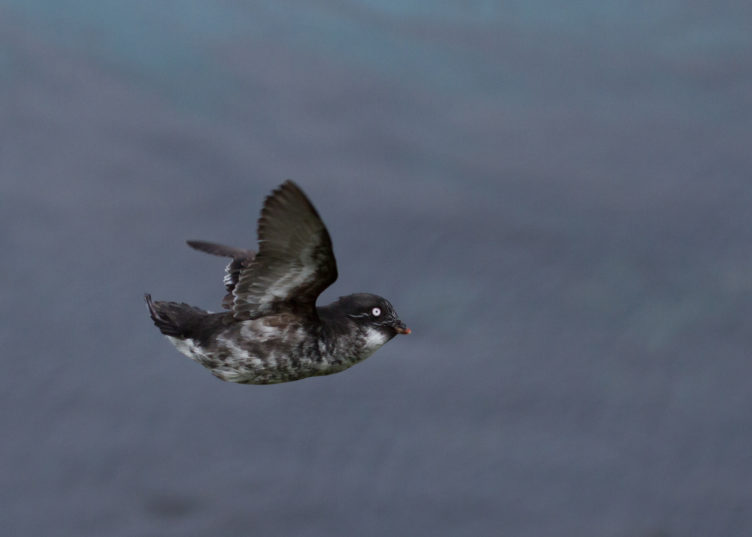
Protecting Marbled Murrelets in the Santa Cruz Mountains
PSG recommends changes to forest fuel management in Marbled Murrelet Conservation Zone 6
October 9, 2026
Forest fuel reduction work is now underway in the Santa Cruz Mountains. Some of it is happening inside the last old-growth redwood stands where Marbled Murrelets still nest. The Pacific Seabird Group (PSG) has written to California State Parks, the San Mateo County Resource Conservation District and San Mateo County Parks. We ask them to change how this work is done in occupied nesting habitat.
Why it matters
The Marbled Murrelet is a seabird that nests high in old-growth trees. It is federally threatened and listed as rare in California. In 2020 the CZU Lightning Complex fire destroyed about 78% of murrelet nesting habitat in Big Basin State Park. Much of what remains is in unburned or lightly burned old-growth in Butano State Park, Portola State Park and the surrounding areas. Long-term monitoring confirms that murrelets nest in these stands.
The fuel reduction work includes felling trees with chainsaws, removing logs, mastication, and using bulldozers and excavators. All of this can disturb nesting birds and degrade their habitat. Based on our scientific expertise, we believe the current plans fall short of protecting murrelets.
What we’re asking for
Only a small part of the project area is in old-growth or occupied stands, so our requests apply only there:
- No forest management work inside occupied stands. This should include a buffer large enough to block noise and other disturbance from nearby work.
- No thinning in old-growth stands. Thinning removes the cover that hides murrelet nests from predators like jays and ravens.
- Prescribed burning outside the breeding season only. Where occupied stands include campgrounds, picnic areas or other busy sites, we support ground-based prescribed burning done outside the breeding season.
Where the current plans fall short
- Buffer zones are too narrow. The plans use a 30 m (100 ft) buffer. PSG recommends 100 m (328 ft). Noise or movement within 100 m of a nest can cause missed feedings, and that can kill chicks.
- The breeding season has been shortened. The accepted season runs 176 days, from March 24 to September 15. Depending on location, the plans cut it to between 134 and 168 days. The cut relies on audio-visual and acoustic survey data, which were never designed to set breeding dates. Late-season birds sitting on nests are quiet and hard to detect, and murrelets often re-nest after a failed attempt. In Zone 6, 10% of known or projected fledge dates fell on or after September 2.
- The noise limits are too high and were measured wrong. The plans allow noise 30–35 dB above ambient levels. The U.S. Fish and Wildlife Service guideline is 20–25 dB. The noise assessment used a “slow” sound meter setting that misses peak sounds, so equipment noise was likely underestimated. We recommend a new assessment by an independent acoustics expert.
- The fire benefit in old-growth is uncertain. Research suggests that ground fuels were not what made the 2020 CZU fire so severe. Old-growth plots that had prescribed burns before the fire burned only slightly less severely than untreated plots, and suitable nest trees were lost in both.
What we’re not opposing
We are not opposing the overall project. We see real value in treating younger redwood stands that were logged in the past. We have no concerns about fuel reduction in Año Nuevo State Reserve or Big Basin State Park, where little nesting habitat remains. We have limited our requests to the minimum needed to protect the murrelet.
State Parks has a long record of conserving murrelet habitat and funding population monitoring in Zone 6. We want to build on that work. We hope to work with the agencies on a plan that improves wildfire resilience and also reflects the best available science on murrelet conservation. Members of PSG’s Marbled Murrelet Technical Committee are available to share data and discuss these changes.
Read the full letter (PDF) → https://pacificseabirdgroup.org/wp-content/uploads/2026/11/2026.10.09PSG_MMTC_Zone6_Letter-1.pdf
Questions? Contact Scott Pearson, PhD, Vice-chair for Conservation, at conservation@pacificseabirdgroup.org.