Seabirds in a changing Arctic – two reviews and a case study
Submitted by: Kathy Kuletz, retired affiliate, U.S. Fish and Wildlife Service, Alaska Region
Seabirds and other upper trophic level (UTL) animals, like fishes and marine mammals, are impacted by climate change throughout the circumpolar Arctic via changes to their habitats and prey. Species affected include perennial residents, breeding-season residents, and non-breeding migrants that use high-latitude oceans at some point in their annual cycle. To consolidate what is known about the impacts of climate change in Arctic ecosystems, two Arctic Council Working Groups – AMAP (Arctic Monitoring and Assessment Program) and CAFF (Conservation of Arctic Flora and Fauna) – invited international teams to conduct reviews as part of a special issue (Frontiers | Climate Change Impacts on Arctic Ecosystems and Associated Climate Feedbacks). In Kuletz et al. (2024a), we reviewed evidence for changes in migratory patterns of UTLs, while Pecuchet et al. (2025) focused on the characteristics and ecosystem impacts of marine heatwaves; these are summarized below.
In northern latitudes, the extent and timing of sea ice are key drivers of animal migratory movements. Warming temperatures, amplified in Arctic regions, has led to reduced ice coverage, longer open-water seasons, and stronger winds, all of which encourage earlier spring production and open-ocean plankton blooms in late summer. The altered seascape drives changes in prey species and prey distributions. For migratory animals (e.g., most UTLs), suitable habitat and prey access is created for some species, while made more limiting for others. Across taxa, a common thread is a shift in the timing and distribution of animals. Published literature and Indigenous Knowledge both indicate that in most cases marine animals, including seabirds, are moving farther north, sometimes shifting longitudinally, and their migrations occur over longer seasonal time frames. For breeding species, a spring miss-match with prey can mean failed reproduction. For long-distance migrants, such as shearwaters and other Procellariids that head north during their non-breeding season, the miss-match can lead to large-scale mortality events or delayed impacts at their southern hemisphere colonies. In all cases, seabirds must iteratively adjust their timing or routing to match the shifts in marine productivity and prey availability.
Overlaid on long-term warming, Arctic and Subarctic regions are predicted to have more frequent marine heatwaves (MHWs). Largely due to accelerated warming and sea-ice loss, high-latitude MHWs appear to have different initiating mechanisms and consequences, compared to those at lower latitudes. The review found that impacts from MHWs were extensive and evident across widely divergent taxa, with greatest impacts in seasonal sea ice zones, where sea ice retreat is most dramatic. Most Arctic species have narrow thermal preferences and are unlikely to find cold climate refugia, and are therefore most vulnerable to MHWs. In contrast, boreal species may benefit from Arctic and Subarctic MHWs, with the warmer conditions facilitating expansion of distributional ranges. Currently, the most documented MHWs for high latitudes occurred in the Bering Sea and Chukchi Sea in 2017–2019. There, the series of MHWs had repercussions across the ecosystem, with shifts in community compositions and multiple food-web interactions.
The Pacific Arctic and Subarctic has experienced multiple MHWs since 2015, but has also been warming for decades, which can make it hard to evaluate ecosystem response and resilience to specific MHW events. The responses of UTL taxa, including seabirds, can be species-specific and range from immediate (physiological limitations, reproductive failures) to intermediate or delayed (large die-offs, redistributions at sea) to long-term (altered migratory patterns and population size).
One approach to examining the impacts of MHWs or different temperature stanzas is to compare two different time periods. This is what we did as part of two Arctic ecosystem research programs in the Chukchi Sea (Kuletz et al. 2024b). We collaborated with multiple investigators sharing the same vessel platforms to examine seabird response (distribution and abundance) to changes in environmental conditions and prey during a relatively cool period (2012, 2013) and one with multiple MHWs (2017, 2019). We modeled at-sea seabird densities for five foraging guilds with respect to multiple oceanographic, prey, and geographic variables.
The warmer years of our study were characterized by warmer, saltier waters as more Bering Sea water flowed northward through the Bering Strait. Compared to the cooler years, abundances of large copepod species and euphausiids were very low, but fish abundance increased dramatically. In particular, age-0 walleye pollock Gadus chalcogrammus inundated the Chukchi Sea. These ecosystem changes ultimately affected seabirds. Species richness of seabirds was elevated during the warm period, but with lower species diversity, largely due to the influx of short-tailed shearwaters Ardenna tenuirostris. As expected, seabird foraging groups showed different responses to oceanographic and prey variables, but within-taxa, relationships often differed between cool and warm periods, perhaps evidence of adaptive responses. However, these adjustments while foraging at sea were not entirely successful, based on findings by others of colony failures and die-offs.
Based on results of this and other studies, we proposed a conceptual model (Fig. 1) that we hope will facilitate exploration of the mechanisms affecting seabirds in Pacific Arctic ecosystems. The model outlines how MHWs affected the offshore seabird community of the Chukchi Sea, primarily via changes in prey species composition and distribution. There was also the potential for direct competition for prey, such as unprecedented increases in the biomass of juvenile cods (Gadidae) that consume the same prey used by planktivorous seabirds.
Ongoing ecosystem alterations challenge the resilience of individual seabirds and entire populations. They also challenge researchers and resource managers. Seabirds have played an important part in telling the story of climate change impacts to Arctic and Subarctic marine ecosystems. The publications summarized in these papers highlight the multitude of approaches needed and varied aspects of seabird ecology that can be used to provide some answers.
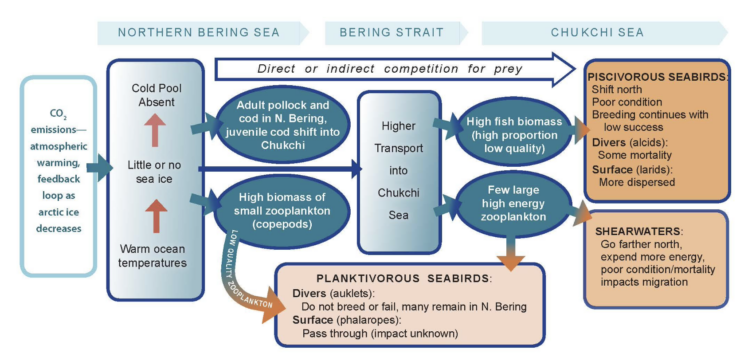
Figure 1. Reprinted from Kuletz et al. 2024b. A conceptual model illustrating the physical drivers and biological components of the Chukchi Sea ecosystem that can affect seabirds during marine heatwave years. During 2017–2019, conditions in the Bering Sea (left side) led to lack of a thermal barrier for juvenile pelagic fish and increased the transport of heat, nutrients, zooplankton, and fish through Bering Strait (center) into the Chukchi Sea (right side). Planktivorous seabirds (breed in the Bering Sea and Bering Strait) can be directly affected by lack of large zooplankton, and their post-breeding migration to the Chukchi curtailed. Piscivorous seabirds (breed in Bering and Chukchi regions) can be directly and indirectly affected via competition with pelagic fish, but surface foragers can search farther for prey. Shearwaters (non-breeding migrants) can be impacted by lack of sufficient, high-lipid prey and perhaps, by the energetic cost of traveling farther north in search of prey.
Citations
Kuletz KJ, Ferguson SH, Frederiksen M, Gallagher CP, Hauser DDW, Hop H, Kovacs KM, Lydersen C, Mosbech A and Seitz AC (2024a) A review of climate change impacts on migration patterns of marine vertebrates in Arctic and Subarctic ecosystems. Front. Environ. Sci. 2:1434549. doi:10.3389/fenvs.2024.1434549
Kuletz KJ, Gall AE, Morgan TC, Prichard AK, Eisner AB, Kimmel DG, De Robertis A, Levine RM, Jones T, Labunski EA (2024b) Seabird responses to ecosystem changes driven by marine heatwaves in a warming Arctic. Mar. Ecol. Progr. Ser. 737: 59-88. doi:10.3354/meps14493
Pecuchet L, Mohamed B, Hayward A, Alvera-Azcárate A, Dörr J, Filbee-Dexter K, Kuletz KJ, Luis K, Manizza M, Miller CE, Staehr PAU, Szymkowiak M and Wernberg T (2025) Arctic and Subarctic marine heatwaves and their ecological impacts. Front. Environ. Sci. 13:1473890. doi:10.3389/fenvs.2025.1473890