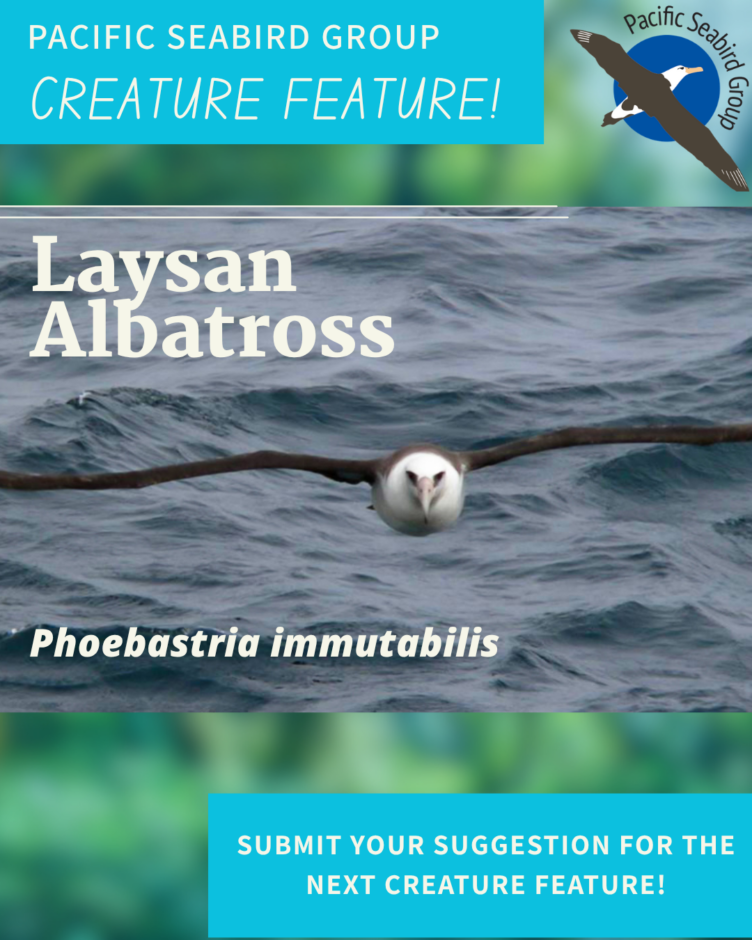
Creature Feature: Laysan Albatross
Pacific Seabird Group presents a new monthly initiative: the Creature Feature! Each month, PSG will highlight a different species and provide some fascinating facts along the way.
We’re kicking things off with the Laysan Albatross, or Mōlī (Phoebastria immutabilis). The Laysan Albatross has a wingspan of around six feet and is highly pelagic, spending most of its life over the open ocean and coming ashore primarily to breed. They can even sleep while flying over the ocean! Laysan Albatrosses form long-term pair bonds and lay just one egg per breeding season. After fledging, young Laysan Albatrosses can spend years at sea before returning to land. As long-distance travelers of the Pacific, Laysan Albatrosses remind us how closely seabirds are connected to the health of the ocean they call home.
🌊 Habitat
Laysan Albatrosses primarily breed on remote islands and atolls in the Pacific, with major breeding colonies in the Northwestern Hawaiian Archipelago, including Midway Atoll. Outside the breeding season, they disperse widely across the North Pacific Ocean and into the Bering Sea in search of food, with some birds traveling as far as the waters off Japan and California.
🌱 Conservation
Conservation Status: Near Threatened (IUCN Red List)
Laysan Albatrosses face threats from fisheries bycatch, entanglement in fishing gear and marine debris, and ingestion of plastic and exposure to other pollutants.
✨ Fun Fact
Wisdom, a Laysan Albatross at Midway Atoll, is the world’s oldest known wild bird and the oldest known banded bird. She was first banded in 1956 and has continued returning to Midway Atoll to breed for decades. She returned for the 2025–2026 breeding season.
Photo Credit: Elizabeth Labunski, U.S. Fish and Wildlife Service; NOAA/OER/Hidden Ocean 2016: The Chukchi Borderlands; License: CC BY 2.0
Source: https://www.noaa.gov/noaa-collections/photo-library/anim2629jpg