Birds with Fish: Studying the diets of Oregon’s coastal birds alongside community scientists
Submitted by: William L Kennerley and Rachael A Orben, Department of Fisheries, Wildlife, and Conservation Sciences, Oregon State University, Hatfield Marine Science Center, Newport, Oregon
Bill-load photography can be an effective means of diet sampling for a number of seabird species (1). Many alcids and terns, for instance, carry prey back to the nest site in their bills, allowing researchers to not only identify the prey species represented, but also count and estimate the size of prey item(s). Even outside of the breeding period, this technique can allow snapshot glimpses into what birds are consuming for self-provisioning.
While bill-load photography does have distinct limitations, as with all means of diet assessment (2), photography-based studies of certain species have revealed similar diet compositions as through the use of molecular methods (3, 4). What’s more, photography can be much cheaper than using fecal DNA or stable isotopes, and very little training is required to collect photographic records. Several recent studies have used crowd-sourced photographs of feeding birds to study seabird diets with great success (5, 6). Beyond being an inexpensive means of collecting great quantities of data, community/citizen science (when done right) can be an effective way of collecting valuable information while simultaneously educating and fostering relationships with the curious public (7).
For these reasons, Oregon State University (OSU) graduate certificate student Noah Dolinajec helped launch the Birds with Fish community science initiative in 2021. Through the help of local conservation organizations and Bird Alliance (formerly Audubon) chapters, Birds with Fish began to garner local support. Using a simple, online submission form (https://blogs.oregonstate.edu/coastaloregonbirds/), community scientists can easily share their photographs — plus a few accompanying pieces of metadata — with our research team in OSU’s Seabird Oceanography Lab.
In many ways, bill-load photography is an ideal way for us to involve community members in scientific research. The Oregon Coast draws large numbers of birders and nature photographers, many of whom already take the kinds of photographs we’re seeking. It’s also a low-commitment kind of community science that’s available to people from diverse socioeconomic backgrounds; there are no regular time commitments, and while photographing some species, like Tufted Puffins (Fratercula cirrhata), requires an expensive camera with hefty zoom lens, others, like guillemots and cormorants, may be photographed from harbors and jetties with inexpensive equipment, sometimes just by digi-binning! If conditions are right, large numbers of photographs may be collected with ease, often without much physical effort. Our research team handles all the bird and prey identification and stores the photographic records, allowing us to easily proof our data and ensure data quality remains high; this is an advantage over checking the identity of many suspicious eBird records.
As Birds with Fish nears its fourth year, our project is nearing 400 submissions, representing at least 31 prey types (fish and marine invertebrates) being consumed by 32 species of marine and estuarine birds. Now, thanks in part to a two-year grant from the Oregon Conservation and Recreation Fund, we are able to devote more time and resources to the project. We’re hopeful that more chances to share and talk about our program with the nature-curious public will help us collect more valuable information on the diets of Oregon’s coastal birds, and will be a vehicle through which we can share information about the many threats that these birds face. Please help us spread the word about Birds with Fish and our efforts to work with community scientists as we seek to learn more about the diets of Oregon’s coastal birds.
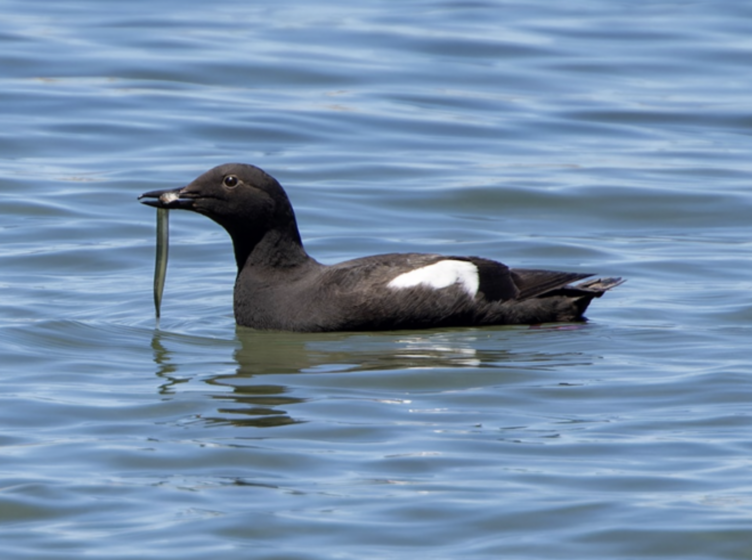
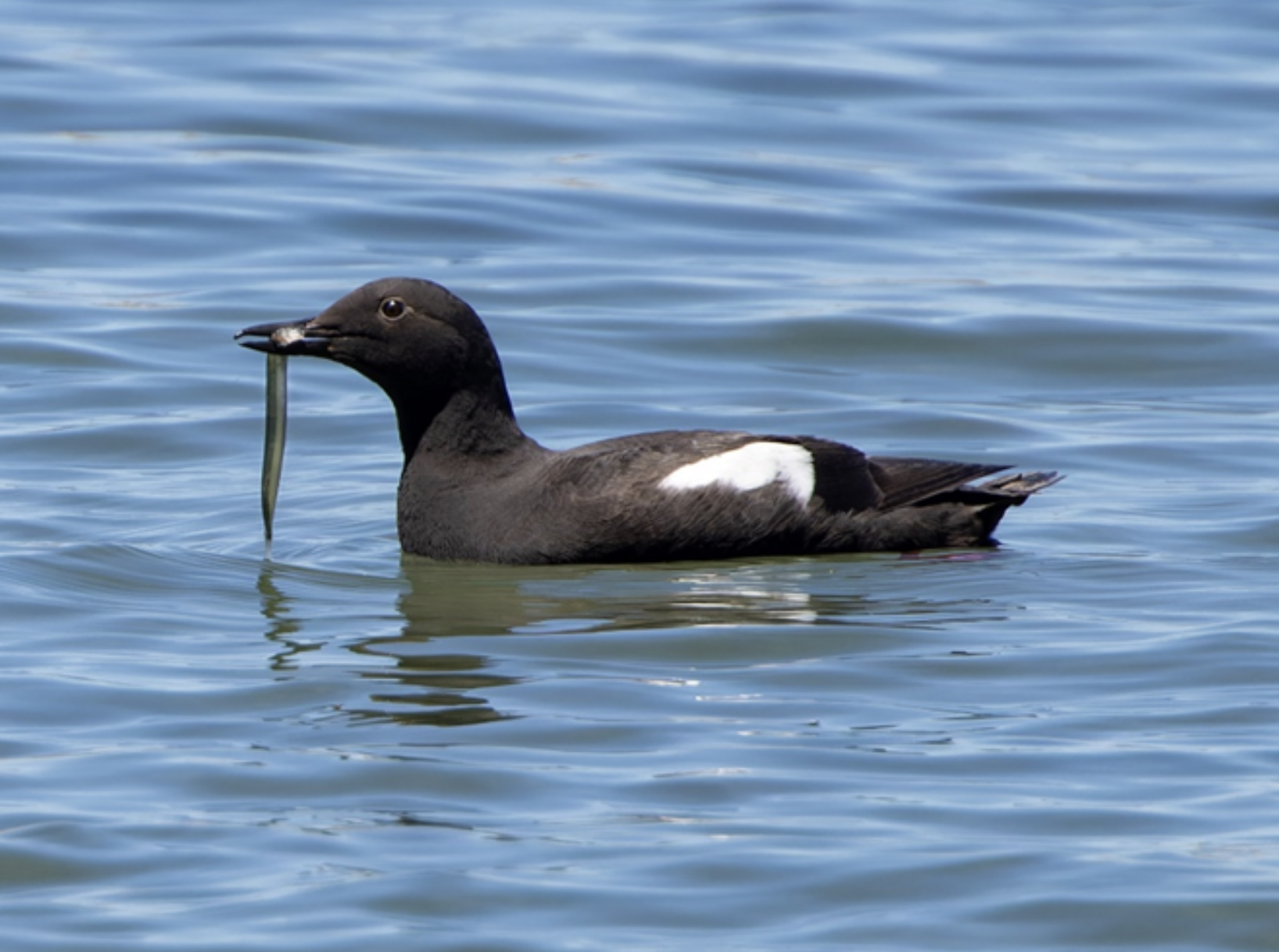
Figure 1. One of the photos submitted to Birds with Fish – a pigeon guillemot (Cepphus columba) feeding on a Pacific Sandlance (Ammodytes personatus) in Alsea Bay, Oregon. Photograph by Roy Lowe.
- Gaglio, D., Cook, T. R., Connan, M., Ryan, P. G. & Sherley, R. B. Dietary studies in birds: testing a non-invasive method using digital photography in seabirds. Methods Ecol Evol 8, 214–222 (2017).
- Barrett, R. T. et al. Diet studies of seabirds: a review and recommendations. ICES Journal of Marine Science 64, 1675–1691 (2007).
- Kennerley, W. L., Clucas, G. V. & Lyons, D. E. Multiple methods of diet assessment reveal differences in Atlantic puffin diet between ages, breeding stages, and years. Front Mar Sci 11, (2024).
- Clucas, G. V, Stillman, A. & Craig, E. C. From presence/absence to reliable prey proportions: A field test of dietary DNA for characterizing seabird diets. bioRxiv 2024.03.22.586275 (2024) doi:10.1101/2024.03.22.586275.
- Forys, E. A. & Hevesh, A. R. Investigating Black Skimmer Chick Diets Using Citizen Science and Digital Photography. Southeastern Naturalist 16, 317–325 (2017).
- Owen, E. et al. Spatial and within-season variation in the diet of a declining seabird described through digital photography and citizen science. Avian Conservation and Ecology 19, (2024).
- Fraisl, D. et al. Citizen science in environmental and ecological sciences. Nature Reviews Methods Primers 2, (2022).