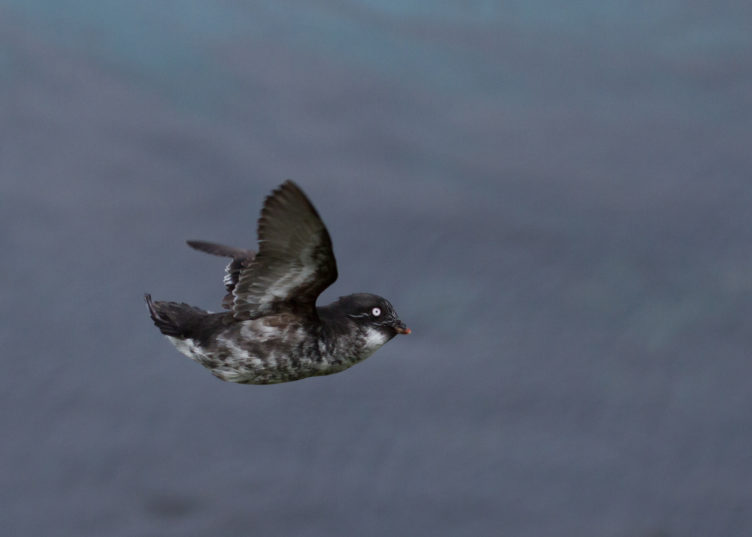
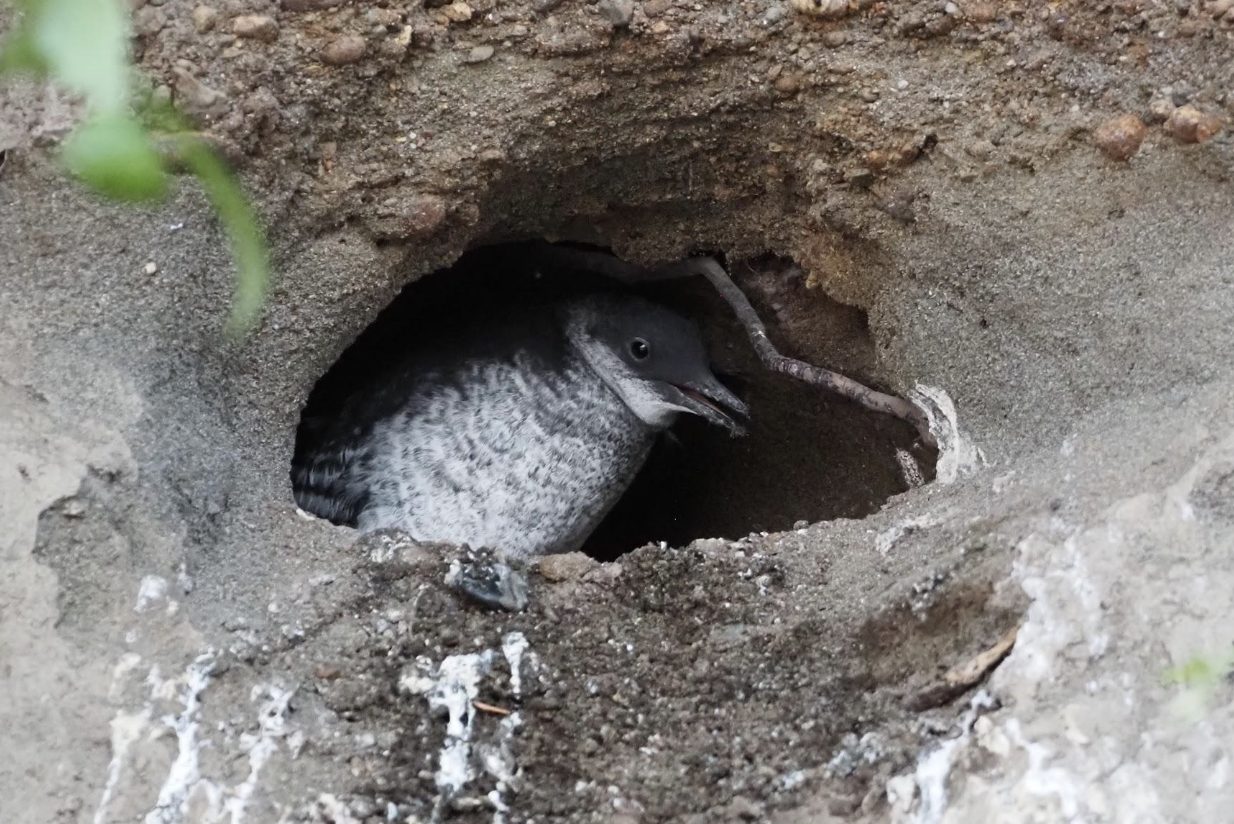
An eyewitness account of two Pigeon Guillemots (Cepphus columba) chicks fledging from their nest
Submitted by: Maria M. Ruth and Susan Morgan, Salish Sea Guillemot Network, Olympia, Washington
On the evening of August 11, 2024, two Pigeon Guillemots (Cepphus columba) were observed departing from their nesting burrow located in an erosional bluff on Eld Inlet, near Olympia, Washington. The burrow is among several in an active Pigeon Guillemot breeding colony located along a 2,000-foot stretch of privately owned beach backed by partly vegetated erosional bluffs. The burrow was approximately 12 feet above a sand-and-gravel beach and visible with the naked eye.
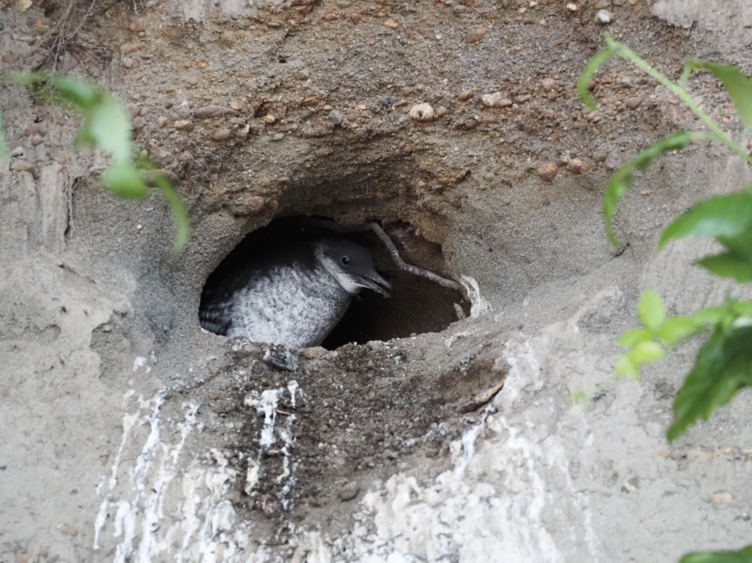
At 8:24 p.m., the observer witnessed the first chick flying from the direction of the burrow directly toward the water where it landed an estimated 60 feet from the tide line and immediately dove and was lost to sight. The rising tide was at +10.9 feet, which exposed approximately 40 feet of the beach between the base of the bluff and the water line. The fledging bird therefore flew a total distance of approximately 100 feet on a straight and direct trajectory from its burrow to the water. No other guillemots were observed on the water or in the vicinity of the burrow before or after the chick fledged.
The observer then climbed into a multi-trunked red alder tree approximately 40 feet tall. The alder was rooted in the base of the bluff, with its main trunk growing at a 45-degree angle and extending its branches over the beach. Several days earlier, the observer discovered that certain branches were sturdy enough to climb and afforded an eye-level view of the entrance to the guillemot nesting burrow and of several inches of the burrow interior. From this vantage point, the distance between the observer and the burrow was approximately 20 feet. The alder was fully leafed out and provided camouflaging cover for the observer.
Starting at 8:26 p.m., the second chick was observed sitting at the entrance to the nest, lifting its wings, stretching its wings behind it, peering over the edge of the nest and toward the water. Sunset occurred at 8:27 p.m. At 8:34 p.m., the chick stepped to the edge of the burrow entrance, turning its head in all directions at the bluff, peering and leaning forward toward the water, lifting and stretching its wings behind it. Civil twilight ended at 9:01 p.m. At 9:03, with no preparatory wing flapping, the chick launched itself quickly from its nest. It flew quickly, directly to the water approximately 30 feet from its burrow to the water. The tide was then +12 feet, exposing an estimated 30 feet of beach from the base of the burrow to the water line. The total distance of this flight is estimated at 60 feet.
The observer described this flight as “graceful,” and the bird as a “silent white streak.” The event occurred so quickly, she reported, that she would have “missed it if she had blinked.”
Neither the first or second fledging chick flapped their wings on their initial flight. As with the first chick, the second chick immediately dove after it landed on the water and disappeared from sight. Neither chick was observed in the offshore waters in the vicinity of the bluff during several days after the fledging event.
The observer is a volunteer surveyor with the Salish Sea Guillemot Network, a community-science project that has trained volunteers to collect scientific data on breeding Pigeon Guillemots in the Salish Sea since 2003. The burrow described here was first monitored in 2018. Adult guillemots were observed visiting the burrow in 2018 and 2019, but no fish deliveries were observed (an indication of the presence of chicks). No adults visited the burrow in 2020. Official summer surveys were discontinued after 2020 due to lack of guillemot activity.
Observations reported here were made irregularly beginning on June 22, 2024, when an adult guillemot was seen flying into the burrow described here. On June 25, an adult could be seen sitting inside the burrow entrance. On August 3, chicks in their juvenile plumage were observed moving to the burrow entrance just prior to the delivery of a gunnel (Pholis spp.). Daily and nightly watches of this burrow began at this time. Over the next nine days, fish deliveries continued with multiple deliveries throughout the day, just after sunrise to after dusk, with two adults delivering fish nearly simultaneously to the burrow. Fish were either gunnel or sculpin (Cottoidea spp.). By August 8, the chicks were observed at the entrance of the burrow outside
the fish-delivery period and audibly vocalizing when fish were delivered. On August 10, chicks were increasingly active near the burrow entrance and were observed stretching out their wings, preening, and peering out the entrance in different directions. On August 11, the night of the fledging, the adults delivered fish to the burrow at 7:08 p.m., just an hour prior to the departure of the first guillemot chick. No adult guillemots were observed in the vicinity of the burrow or holding fish to lure the chicks from the nest as has been documented in the literature.
Eye-witness observations of Pigeon Guillemot fledging behavior are rare and/or rarely documented. The species account of the Pigeon Guillemot, published in 1993 in Birds of North America (now Birds of the World), states that fledging occurs “[M]ostly at night or in lateevening, independent of parents…but sometimes during the day in Washington” and that the
young “scramble, or fly clumsily down to the water… ”. That young guillemots “fly clumsily” is supported by a single cited account stating that some birds “merely waddled to a position where they could drop into the water without even becoming airborne and flew considerable distances before splashing into the water with a series of ‘skips’ … ” and “even flipped over three times before coming to a stop.” Other birds “left the nest and flew rather erratically and unstably into the water.”
The observations presented here offer alternative and supplemental details.