Hipfner et al. (2025)
Author Information
Mark Hipfner, Hannah Avenant, Christine Rock, Sonya Pastran, Sarah Hudson, Nikolas Clyde, Devin de Zwaan, Neena Pradal, Zoe Crysler, Anneka Vanderpas, Hannah Hall, Jesse Russell, Tessa Craig, Katie Chettle and Guy St.-Amour: Environment and Climate Change Canada
Mary-Lynne Henderson: Gwa’sala-Nakwaxda’xw Nations, Port Hardy
Rhythm Donkersley: Kitsumkalum First Nation, Terrace
Katelyn Stoner: Oregon State University
Marie Auger-Methé and PhD student Shabnam Shadloo: (University of British Columbia, Vancouver)
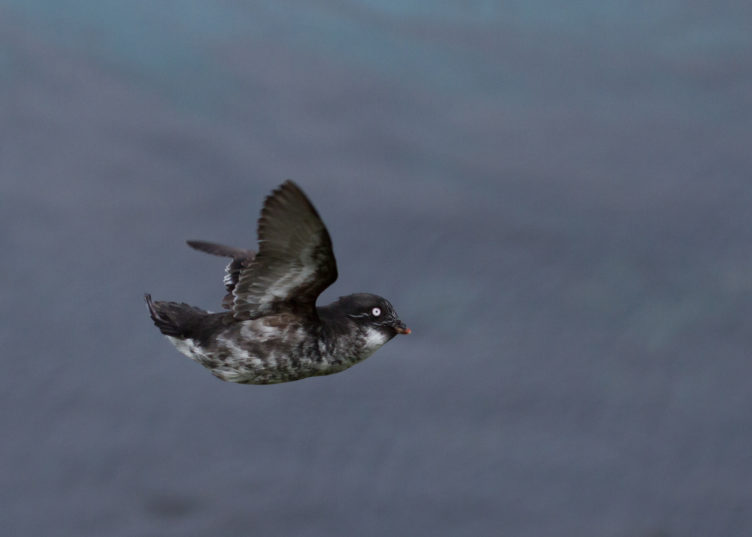
Mark Hipfner (Environment and Climate Change Canada (ECCC), Delta – Wildlife Research Division) reports that summer 2024 marked the 31st year of operation of the Centre for Wildlife Ecology’s (CWE) seabird research program on Triangle Island. Triangle Island supports the largest aggregation of breeding seabirds in the eastern North Pacific Ocean south of Alaska, and British Columbia’s most diverse seabird community of 13 breeding species. The 2024 field crew consisted of Hannah Avenant (ECCC, Delta – Canadian Wildlife Service), Christine Rock (ECCC, Nanaimo – CWS), Sonya Pastran (ECCC, Victoria – Wildlife Research Division), Sarah Hudson (ECCC, Delta – WRD), Nikolas Clyde (ECCC, Delta – WRD), and Devin de Zwaan (ECCC, Delta – WRD). The research program in 2024 collected information on diets of nestling Cassin’s Auklets (Ptychoramphus aleuticus), adding to a long-term dataset for this SAR-listed species, a Climate Change sentinel. Other projects on Triangle Island in 2024 included deploying GPS tags on 10 adult Tufted Puffins (Fratercula cirrhata) as part of a multi-year, multi-species program under the Ocean Protection Plan (OPP) to delineate the at-sea distributions of key seabird species, and to assess how effectively the boundaries of the Scott Islands Marine National Wildlife Area envelop key foraging areas for seabirds in the region.
Also under OPP, the Triangle Island field crew deployed 15 GLS tags on Tufted Puffins to delineate at-sea distributions over the annual cycle, in collaboration with PhD student Katelyn Stoner (Oregon State University, Corvallis, OR). GLS tags were retrieved from 2 Tufted Puffins tagged in 2023. The larger project also includes collaboration with US Fish and Wildlife Service researchers, who are deploying GLS tags on puffins on colonies in the Alaska Maritime National Wildlife Refuge.
Research was also conducted on several major Rhinoceros Auklet (Cerorhinca monocerata) colonies in 2024 (Fig. 2). Hannah Hall, Jesse Russell, and Tessa Craig (ECCC, Delta – WRD), visited Gander Island in the Moore Islands Group off BC’s Central Coast; Hipfner, Neena Pradal (ECCC, Delta – WRD), and Zoe Crysler (ECCC, Delta – CWS), along with Mary-Lynne Henderson (Gwa’sala-Nakwaxda’xw Nations, Port Hardy) visited Pine Island off the Central Coast; and Hipfner, Pradal and Anneka Vanderpas (ECCC, Delta – WRD), along with Rhythm Donkersley (Kitsumkalum First Nation, Terrace) visited Lucy Island off BC’s North Coast. The main goal of this program, which was started in 2006, is to study effects of oceanographic variation across multiple trophic levels – the diets fed to nestling auklets and the diets of their major fish prey, the Pacific Sand Lance (Ammodytes personatus) and Pacific Herring (Clupea pallasii). For this project we collaborate with US federal, state and academic researchers who work on Protection Island, WA, in the Salish Sea (Fig. 2). Field crews also deployed GPS tags on 20 Rhinoceros Auklets on Gander Island and 10 GPS tags on Pine Island, continuing a long-term international research project in support of the OPP (Fig. 3). While on the seabird colonies in 2024 we concurrently also completed the twelfth year of a project investigating the consumption of Pacific salmon (Oncorhynchus spp.) by seabirds in BC waters, in collaboration with Strahan Tucker (Fisheries and Oceans Canada (DFO), Nanaimo – Pacific Biological Station); and completed the 16th year of a project investigating the distribution and abundance of microplastics in northeastern Pacific Ocean food webs, in collaboration with Moira Galbraith (DFO, Sidney – Institute of Ocean Sciences).
There was also winter field work completed in early January to early March of 2024. Craig, Hall, Hipfner, Hudson, Pastran, Pradal, Vanderpas, along with Katie Chettle and Guy St.-Amour (ECCC, Delta – WRD), and Marie Auger-Methé and PhD student Shabnam Shadloo (University of British Columbia, Vancouver) trapped Glaucous-winged Gulls (Larus glaucescens) around the BC portion of the Salish Sea. The main goal of this project is to examine food-web contamination and its implications for the physiological health of gulls that spend winter in the region. For outgroups, the crews also sampled on the west (Tofino and Ucluelet area) and north (Campbell River to Port Hardy) coasts of Vancouver Island, along BC’s North Coast (Prince Rupert area), and in Haida Gwaii.